



How Much Does It Really Cost to Start an Online Store?
Starting an online store is often presented as something you can do for the price of a monthly subscription. You see a platform advertised for $20, $30, or $40 per month, and it is easy to assume that this is roughly what your ecommerce business will cost to run.
In reality, that number is usually only the beginning.
The platform itself may be affordable, but a working online store often needs a domain, payment processing, additional apps, email marketing, design tools, and sometimes shipping or inventory software. None of these expenses necessarily look large on their own. The problem is that they accumulate quietly, and by the time your store is operating the way you want, the monthly cost may be very different from the number that originally convinced you to sign up.
That does not mean starting an online store has to be expensive. It means you need to know which costs are essential, which can wait, and which are easy to underestimate.
The Platform Fee Is Only Your Starting Point
Your ecommerce platform is usually the most obvious recurring expense because it is the one you see first.
As of August 2026, Shopify lists its Basic plan at $29 per month when billed annually, while higher tiers increase substantially as businesses need more advanced capabilities. Wix also offers ecommerce-capable paid plans, although its pricing varies by market and plan configuration.
Those figures are useful for budgeting, but they are not the full cost of the store.
A platform subscription generally gives you the foundation: the storefront, product pages, checkout, order management, hosting, and a collection of built-in tools. What it does not necessarily include is every feature your particular business will eventually want.
This is where your real ecommerce budget begins to take shape.
Your Domain Is Small, but It Is Still a Cost
A custom domain is one of the cheapest parts of running an online store, but it is still something people forget when estimating startup costs.
If you are building a serious business, you probably want customers to visit your own domain rather than a free platform subdomain. Domain prices vary depending on the extension and registrar, and some ecommerce platforms include a free domain for the first year with certain annual plans. Wix, for example, currently includes a one-year domain voucher with eligible yearly premium plans.
The important part is not the first-year promotion. It is what happens afterward.
Domain renewals become part of your ongoing operating expenses, so include them in the annual budget even when the first year appears free.
Payment Processing Is the Cost That Grows With Sales
Payment fees are different from most other ecommerce expenses because they increase as your business grows.
If your platform costs $30 per month, it still costs roughly $30 whether you make ten sales or one thousand. Payment processing does not work that way. Every sale creates another processing charge.
At the beginning, the difference may feel insignificant. Once revenue increases, it becomes much more noticeable.
Before choosing a platform, find out which payment processors are available in your country, what they charge for the payment methods your customers are likely to use, and whether your ecommerce platform adds any additional transaction fee when you use an outside provider.
This deserves more attention than many new sellers give it because the cost does not disappear after setup. It follows every successful transaction.
A store that grows from $1,000 to $10,000 in monthly sales will not just have more revenue. It will also have substantially higher payment-processing costs.
That is normal. You simply need to account for it when calculating margins.
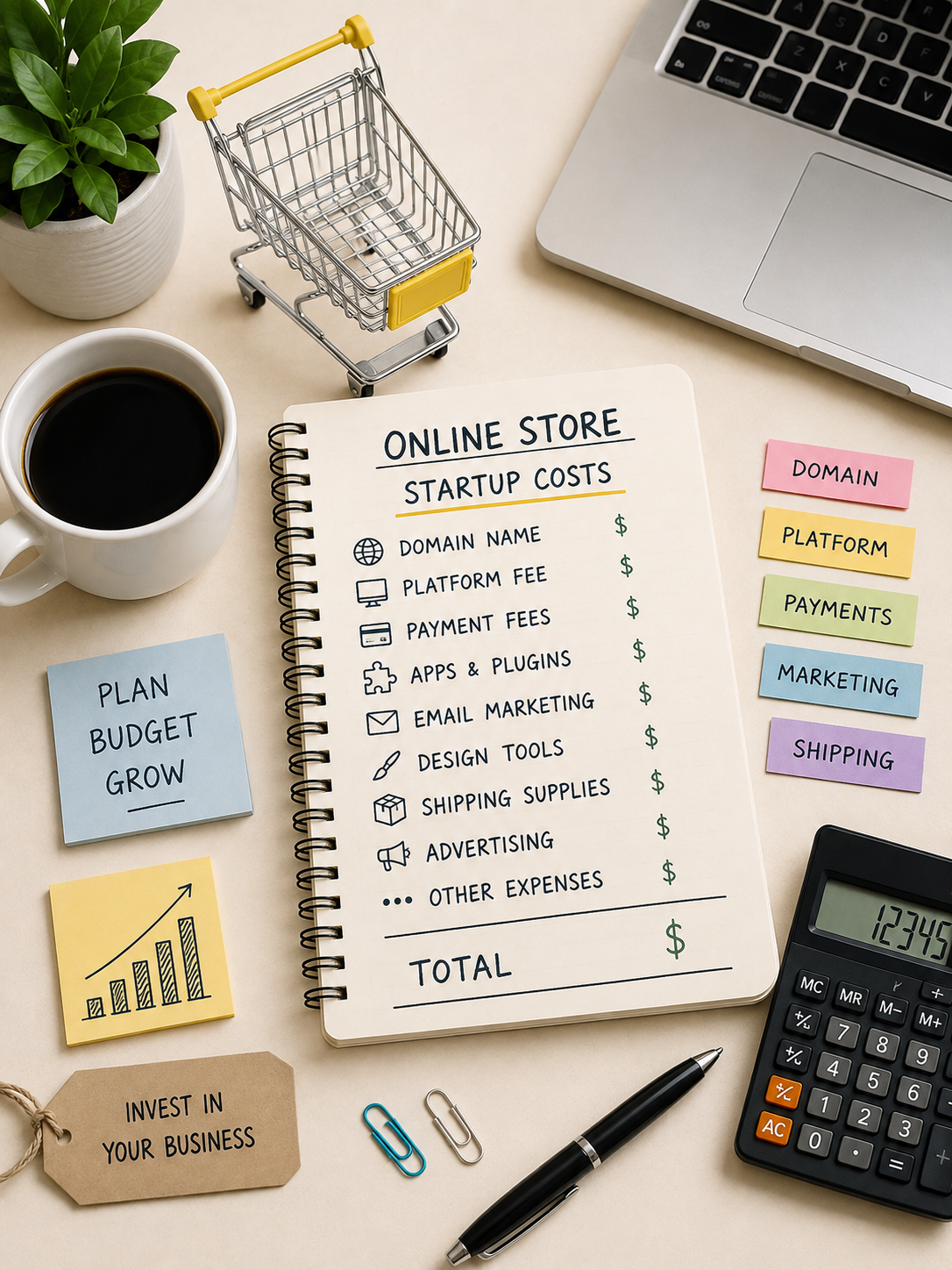
Apps Are Where a Cheap Store Can Become Expensive
This is probably the expense I would watch most carefully.
Ecommerce platforms are increasingly built around app ecosystems. If the basic platform does not do something you need, there is often an app that will add the capability.
Want product reviews? There is an app.
Want subscriptions? There is an app.
Want sophisticated bundles, loyalty programs, upsells, advanced shipping rules, multilingual features, or specialized inventory management? There are apps for those too.
The problem is not that apps are bad. Apps are one of the reasons modern ecommerce platforms are so flexible.
The problem is that recurring subscriptions stack.
You might start with a platform costing $30 per month, then add a $10 review app, a $15 marketing tool, a $20 subscription app, and another service for shipping or inventory. Suddenly the original $30 store is costing $75 or $100 per month before you have spent anything on advertising.
Wix’s own 2026 cost guidance estimates that apps and integrations can range from nothing to more than $100 per month depending on what a site needs.
This is why I would not install an app simply because it looks useful. Start with the problem. If the problem is real and the app saves enough time or increases enough revenue to justify the cost, then it makes sense.
Otherwise, leave it alone.
Email Marketing Often Starts Free and Becomes Paid Later
Email marketing is another cost that sneaks up gradually.
When your store is new and your subscriber list is small, you may be able to use a free plan. Mailchimp, for example, still offers an entry-level free option for small lists, while paid plans scale as contact counts and features increase.
That makes email inexpensive at the beginning.
But a growing subscriber list changes the calculation.
As your audience grows, you may want automation, segmentation, abandoned-cart sequences, product recommendations, or more frequent campaigns. Those features can move you into paid tiers.
This is not necessarily a bad expense. Email can become one of the most useful marketing channels for an ecommerce business because you are communicating with people who have already shown an interest in your products.
The mistake is assuming it will always remain free.
When estimating future costs, include email marketing as something that may begin at $0 and become a meaningful monthly subscription as the business grows.
Design Tools Are Optional Until You Start Creating Everything
Technically, you can build an online store without paying for design software.
Most ecommerce platforms include templates, and free tools are capable of handling basic product graphics.
Then you start running the business.
You need product images, promotional graphics, social posts, banners, email graphics, ads, seasonal promotions, Pinterest pins, and perhaps packaging materials.
For many sellers, a paid design tool eventually becomes part of the workflow.
Canva, for example, offers free tools as well as paid options, including its newer Canva Business plan at $20 per person per month in the U.S. You may not need anything like that when you launch, and paying for a professional design plan before you are using the features would be unnecessary.
But design has a way of becoming an ongoing ecommerce task rather than a one-time setup job.
That means it belongs in the budget, even if you decide to keep the cost at zero initially.
Product Photography Can Cost Nothing—or More Than the Website
This cost varies enormously depending on what you sell.
A seller with a smartphone, good natural light, and simple products may be able to create perfectly usable photos at almost no additional cost.
Another business may need lights, backgrounds, props, photo editing, models, or professional photography.
And product photography is not something to dismiss as decoration. In an online store, customers cannot touch the product. Your photographs are doing part of the selling.
The sensible approach for a new store is usually to start simple. Use good lighting, clean backgrounds, several useful angles, and images that clearly show what the customer is buying.
You can improve production quality later.
There is little reason to spend thousands of dollars producing a catalog before you have evidence that people actually want the products.
Shipping Costs Are More Than Postage
Physical-product sellers need another budget category that digital sellers can mostly ignore: fulfillment.
The obvious expense is postage, but shipping can involve much more than the carrier fee. You may need boxes, envelopes, labels, protective packaging, tape, printers, label paper, tracking services, or third-party fulfillment.
Even small packaging costs matter when they happen on every order.
Suppose your box, mailer, label, and protective packaging cost only $1.50 per order. At 20 orders, that is trivial. At 1,000 orders, it is $1,500.
This is why shipping costs need to be built into product pricing rather than treated as an inconvenience that you will figure out later.
If you plan to offer “free shipping,” remember that the shipping is not actually free. Either you or your customer is still paying for it somewhere in the economics of the order.
Inventory Is Often the Largest Startup Expense
If you sell physical products, the software may not be the expensive part of starting an online store at all.
Inventory may be.
A business selling print-on-demand products, digital products, or made-to-order goods can launch with very little inventory risk. A retailer purchasing products in advance may need hundreds or thousands of dollars before the first sale happens.
That changes the way you should think about ecommerce costs.
A $29 platform subscription is almost irrelevant if you need $5,000 of inventory sitting in your home or warehouse.
It also explains why starting small can be valuable. A limited product range lets you learn which products customers actually want before committing more cash to inventory.
The store can always become bigger. Unsold inventory is much harder to shrink.
Returns and Refunds Have a Real Cost Too
Returns are easy to forget when building a budget because they do not happen until after sales begin.
Depending on what you sell, a returned order may involve return shipping, damaged packaging, lost processing fees, customer support time, or inventory that can no longer be sold as new.
The percentage varies dramatically by industry, so there is no single number you should apply to every store.
What matters is acknowledging that not every completed order will remain a completed order.
If you operate on very thin margins and have never accounted for returns, even a modest return rate can create unpleasant surprises.
Accounting and Bookkeeping Eventually Become Part of the Business
At the beginning, you might manage income and expenses with a spreadsheet.
That can work.
As order volume increases, however, you may want bookkeeping software, automated sales-data imports, inventory accounting, tax tools, or professional accounting assistance.
This is another category where the right approach is usually not to buy everything immediately.
Start with what you actually need.
But keep clean records from day one.
A small ecommerce business becomes much harder to understand when personal spending, business subscriptions, advertising expenses, inventory purchases, refunds, and sales revenue are all mixed together.
The easier it is to see where money is going, the easier it becomes to decide which tools are earning their place in your business.
What About Advertising?
Advertising can become the biggest expense of all, but I would separate it from the basic cost of creating the store.
You can technically launch without paid advertising.
Whether you can grow without it depends on your products and marketing strategy.
Some businesses attract customers through SEO, Pinterest, social media, marketplaces, referrals, or an existing audience. Others depend heavily on paid traffic.
If you are going to use advertising, do not treat your ad budget as money that automatically creates sales.
Early advertising is partly a learning expense.
You are testing products, audiences, messages, landing pages, and offers.
Until you know your conversion rate and margins, be cautious about scaling advertising simply because traffic increases.
More visitors are not valuable if each sale costs more to acquire than the profit it generates.
A Realistic Starter Budget Can Be Surprisingly Small
The good news is that you do not need every tool mentioned in this article on day one.
A lean online store might begin with an ecommerce platform, a domain, basic payment processing, free email marketing, free design software, and little or no paid advertising.
That can keep the initial software budget relatively modest.
Wix’s current 2026 guide estimates ecommerce functionality at roughly $20 or more per month before payment processing, while apps can range from free to more than $100 per month depending on what you add. Shopify’s current published Basic pricing gives another useful benchmark at $29 per month on annual billing.
So a very simple store might cost only a few hundred dollars in software over its first year.
But that number can rise quickly once you add premium apps, paid email marketing, design services, advertising, professional photography, inventory, or fulfillment.
This is why giving one universal answer to “How much does it cost to start an online store?” is misleading.
A better answer is: it depends on how much of the business you are trying to build before you have customers.
Spend Money Where It Removes a Real Problem
One of the easiest ways to overspend on ecommerce is buying tools for the business you hope to have rather than the business you currently have.
You see an advanced email automation platform and imagine thousands of subscribers.
You install an inventory system designed for multiple warehouses.
You buy premium analytics software.
You upgrade your design tools.
Individually, every purchase seems reasonable because it might become useful later.
Collectively, you have created a surprisingly expensive business before proving that customers will buy anything.
A better rule is simple: let problems earn the tools that solve them.
If managing orders manually becomes painful, look for an order-management tool.
If your email list grows beyond what your current service can handle, upgrade.
If creating graphics starts consuming hours every week, a better design workflow may be worth paying for.
This keeps your expenses connected to actual business needs instead of hypothetical ones.
The Real Cost Is Not Just Money
There is one final ecommerce expense that does not appear on your credit-card statement: your time.
A cheaper system that requires hours of troubleshooting can be more expensive than a slightly higher-priced tool that simply works.
The same applies to apps, marketing software, shipping systems, and design tools.
Every new service has a learning curve. Every integration needs occasional attention. Every complicated workflow takes time away from products, customers, and marketing.
This is why the cheapest possible ecommerce stack is not necessarily the smartest one.
You are looking for the point where cost and simplicity make sense together.
So How Much Should You Budget?
For a small business starting cautiously, I would think in layers rather than trying to guess one perfect number.
First, budget for the essentials: your ecommerce platform, domain, and payment processing.
Next, identify the tools you genuinely expect to need during the first few months, perhaps email marketing or one important app.
Then keep a separate budget for growth expenses such as advertising, additional apps, better design tools, professional photography, or more sophisticated fulfillment.
Most importantly, review those costs periodically.
An app that was useful six months ago may no longer be necessary. A free tool that worked when you had 50 customers may no longer work when you have 5,000. Your ecommerce costs should change because the business changes, not because subscriptions quietly accumulate.
Starting an online store can still be relatively inexpensive. You just need to look beyond the price printed on the platform’s homepage.
The real question is not, “How cheaply can I launch?”
It is, “What do I actually need to spend to create a store that customers can buy from and that I can realistically manage?”
That is a much better number to build your business around.
✅ Last Updated on August 12, 2026 by GET Great Picks Team